
Remodeling Tips · 6 min read
Who Installs Your Appliance Panels? Manufacturing vs. Mounting
By Sam Caprar | Founder & President, Copper Canyon Millworks
I spent yesterday on three jobsites, all of them working through cabinet and appliance coordination. Appliance panels came up again. They usually do.
The panels themselves are rarely the problem. They get built, they get finished, they arrive correct. What goes wrong is that nobody has settled who puts them on, and that question tends to surface in the week everything is supposed to come together — which is the worst possible time to be asking it.
It is worth understanding early, because the answer affects how the panel gets built, not just who carries it across the room.
Two Jobs That Sound Like One
Making a custom appliance panel and mounting that panel to an appliance are two different jobs governed by two different sets of rules.
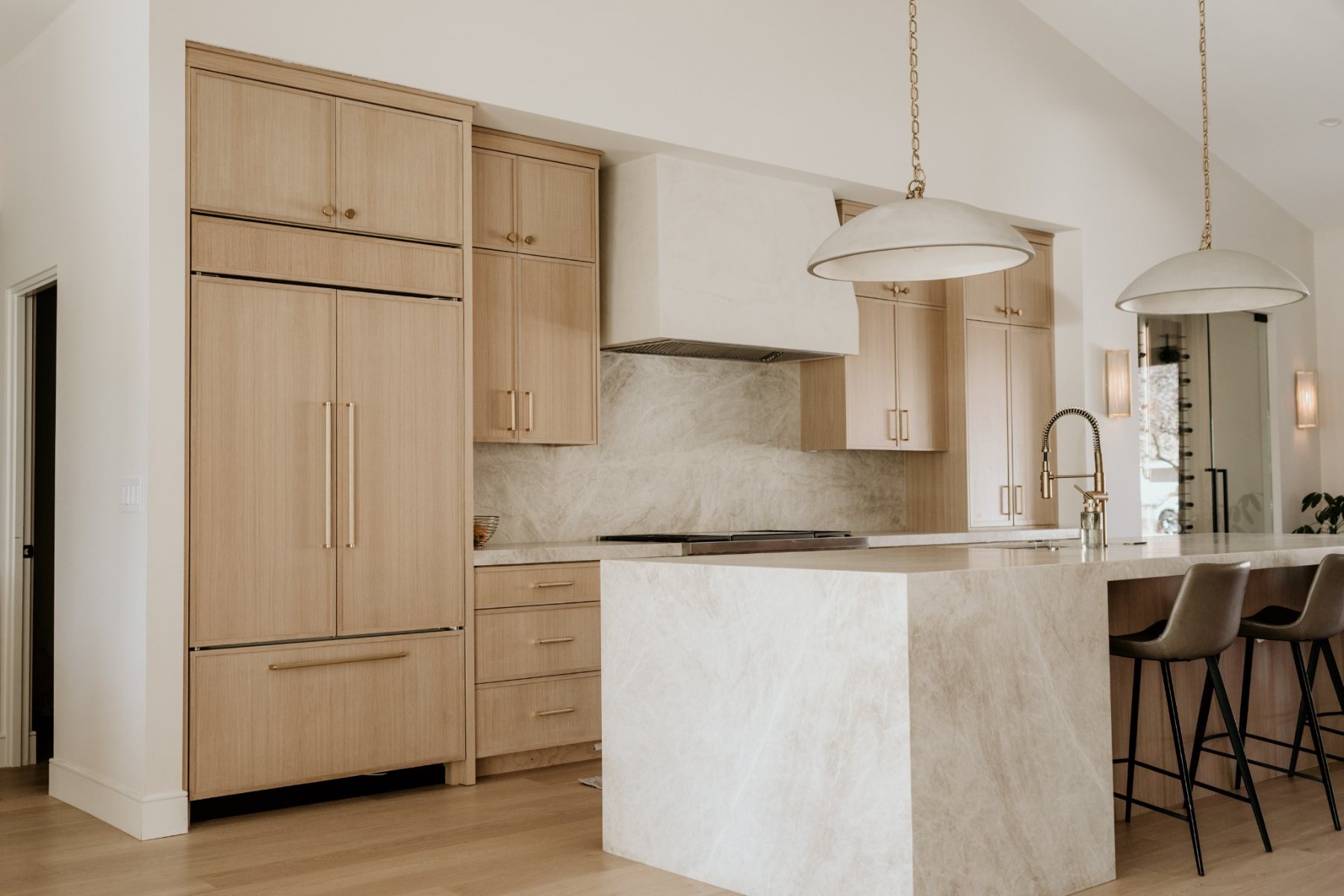
The panel itself is cabinetry. It is drawn, machined, assembled and finished the same way a door is, to match the run it sits in. That is our work, and we build panels for integrated refrigeration, dishwashers, undercounter units and beverage columns.
Mounting it is appliance work. The panel attaches to brackets on the appliance door, using that manufacturer’s hardware and that manufacturer’s instructions, and the appliance then has to be adjusted to carry it. At Copper Canyon, installing panels onto appliances is not part of our standard scope. We do supply and fit the decorative hardware, which is usually where the confusion starts — if the cabinetmaker is handling the handles, people reasonably assume the cabinetmaker is handling the panels too.
Those are separate things, and the reason has less to do with who owns which tools than with what happens after the panel goes on.
The Panel Is Built to a Number
Every integrated appliance that accepts a custom panel publishes a maximum panel weight. It is a specification, not a guideline, and the range across brands is much wider than most people expect.
Sub-Zero’s Designer Series installation guide sets the limit by unit: 15 pounds for a drawer panel, 45 pounds for an 18-inch column, 50 pounds for a 30-inch tall door, and 75 pounds for a 36-inch column. The Classic Series guide allows 75 pounds on four specific models and 50 on the rest. Dishwashers live in a different world entirely — Thermador’s planning guide says its fully integrated models accept panels from 7 to 24 pounds but ship from the factory set for 11 to 18, and Miele has published maximums of 21 pounds on one integrated series and 16.5 on another.
Thickness is specified too, and separately. Sub-Zero requires a minimum of 5/8 inch on Designer models and 3/4 inch on Classic. Miele’s integrated dishwasher instructions call for at least 3/4 inch where the mounting bracket screws in. Sub-Zero also warns that a panel thicker than an inch may need a 90-degree door stop to keep the door from damaging the unit or the cabinetry next to it.
Put those together and you can see why the appliance has to be chosen before the panel is drawn. A 36-inch slab in walnut at a full inch is a fundamentally different object from a 5/8-inch paint-grade panel, and only one of them may fall within the manufacturer’s specifications for a given door. Species, thickness, construction and hardware all land on the same scale.
Do not take the numbers above as current for your project. They are here to show the spread. The only figures that matter are the ones on the spec sheet for the exact model being installed.
The Appliance Gets Adjusted to the Panel
Here is the part that decides where the responsibility sits.
Once a panel is on, the appliance has to be tuned to its weight. Miele’s integrated dishwasher instructions describe the test plainly: open the door halfway and let go. If it stays put, the spring tension is right. If it drops, increase tension. If it pulls itself closed, reduce it. The adjustment is a screw behind the door, turned by hand with a Torx driver — and if the springs cannot be adjusted far enough to hold the door, the manual’s conclusion is that the panel is too heavy and the machine needs stronger springs from the dealer.
Sub-Zero’s refrigeration panels work differently but the principle is the same. The panel hangs on screws deliberately left proud, then gets squared with adjustment cams, then everything is tightened. The door is being set up around the panel after the panel exists.
That is a mechanical adjustment to a warrantied appliance, performed after our product is attached to it. Miele’s manual states that installation and repair work should be done by an authorized service technician, and that work by unqualified people may be hazardous and may void the warranty.
So when an appliance installer declines to hang a panel somebody else built, or asks for the weight before touching it, they are not being territorial. They are following the manual that stands behind the machine. In my experience the appliance crews are right to ask, and the projects that go badly are the ones where nobody asked at all.
Sequence matters for the same reason. Miele requires the handle to be fitted to the panel before the panel goes onto the machine, with countersunk screws so the back sits flat against the bracket. Fit the hardware in the wrong order and the panel comes back off. That is hardware — our scope — governed by an appliance instruction.
What to Settle Before Installation Day
None of this is difficult. It is only difficult late. These are worth pinning down in writing, early, while there is still time to act on the answers:
- Exact model numbers, not categories. “Panel-ready dishwasher” is not a specification. The model number is.
- The weight and thickness limits for each unit, in hand before panels are drawn — not after.
- Who mounts the panels, named before the appliances are delivered.
- Who adjusts the doors once the panels are on.
- When the decorative hardware gets fitted, relative to panel mounting.
- Who takes the panel off if the appliance ever needs service, and who puts it back.
Six answers, gathered at specification rather than at installation, can prevent many of the problems I keep running into on site.
How We Build
We manufacture appliance panels to the appliance maker’s published specification, and we finish them on every face, because the back and edges are visible every time the door opens. We ask for model numbers early — not to be bureaucratic, but because the panel genuinely cannot be drawn until the appliance is known. We supply and fit the decorative hardware.
We leave mounting and appliance adjustments to the responsible appliance installer, so those tasks are handled under the appropriate installation requirements. It is not about avoiding the work. Splitting that responsibility helps nobody when a door starts dropping two years later.
If you are planning a kitchen with integrated appliances, bring the appliance list to the design conversation. It is one of the few decisions that genuinely has to happen early. You can see how we approach project coordination in our process, and more on what separates a manufacturer from a dealer in who actually builds your cabinets.
Book a consultation and bring the appliance spec sheets. We will tell you what the panels can be before you fall in love with a drawing.
Have a project in mind?
Book a consultation and we'll walk you through what it would take, start to finish.
Book a ConsultationKeep Reading
Related Reading
Care Tips
How to Care for Your Custom Wood Cabinets
Simple daily habits that keep custom cabinetry looking and functioning like new for decades, not just years.
Custom Cabinets
The Truth About "Made in USA" Cabinet Claims
Not every cabinet labeled 'American-made' is actually built here. Here's what the label can hide, and what to ask before you buy.