
Custom Cabinets · 8 min read
Why We Order Cabinet Doors by Room: Consistent Wood Grain
By Sam Caprar | Founder & President, Copper Canyon Millworks
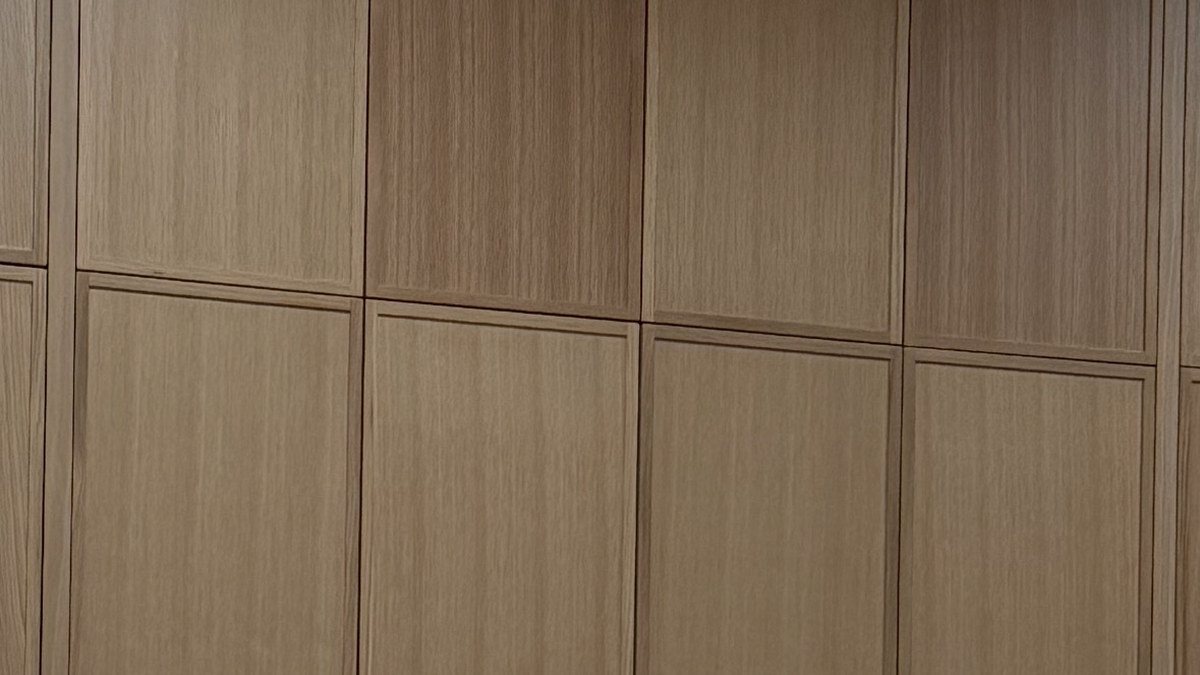
I looked at a rift-sawn white oak kitchen recently. Skinny Shaker doors. The cabinetry was well built — clean joinery, consistent reveals, a careful installation. Whoever made it knew what they were doing.
What caught my eye was the wood. Adjacent doors did not quite agree with each other on color. On several doors, the solid frame around the outside read differently from the veneered panel in the middle — close, but not the same, with a visible line where they met.
That is not a workmanship problem. You cannot sand your way out of it. It is a materials problem, and nearly all of it is settled before anyone turns on a machine. It comes down to where the wood came from and how the order was placed.
Worth understanding if you are specifying white oak, because the difference between a kitchen that reads as one piece and a kitchen that reads as a collection of doors is mostly a purchasing decision.
Rift-Sawn White Oak Is Still a Tree
Rift sawing is a cutting method, not a uniformity guarantee. The log is cut so the growth rings meet the face of the board at a steep angle, which gives you the tight, straight, almost pinstriped grain people want in a modern kitchen. It suppresses the cathedral arches of plain sawn and most of the ray flake of quarter sawn.
It does not make every board the same color.
TruStile, a door manufacturer, publishes a material page for rift-sawn white oak saying the species “varies in color from light grayish-tan to brown.” The same page tells customers to expect mineral streaks — discolorations from mineral deposits the tree absorbed out of the soil, typically gray to black — and small pin knots dispersed across a door face. Heartwood runs mid to dark brown, sapwood runs white to light brown, and a single board can carry both.
As one cabinet manufacturer puts it in its own customer guidance on white oak: even in the same tree, no two boards will be identical.
So you start with a material that moves around in color and figure by nature. Everything after that is about how much of that variation ends up next to itself.
Two Materials in Every Door
A flat-panel door in this style is usually not one material. The frame — stiles and rails — is solid sawn lumber. The center panel is typically a veneered sheet: a thin slice of white oak bonded to a stable core.
There is a good reason for that. A solid panel of that width moves with the seasons, expanding and contracting across the grain, and in a dry climate that shows up as a gap at the panel edge or a broken line in the finish. A veneered panel over a stable core is far less prone to that movement. It is the right engineering choice, and it is what we use.
It also means every door typically contains two materials that took different paths to get there. The solid lumber is sawn from a log at a mill. The veneer is usually sliced from a different log, often at a different facility, and pressed onto a core. Same species, same cut name, but commonly two separate production streams.
That is why visual coordination between solid lumber and veneer has to be a deliberate step in manufacturing. It is not something that happens on its own because both pieces are called rift-sawn white oak.
They do not necessarily respond to finish the same way either. Even when solid lumber and veneer are the same species, differences in grain, natural color, surface preparation, and finishing response can produce visible variation. Two pieces of genuine rift white oak, finished together with the same material, can still land a shade apart.
Skinny Shaker is where I tend to notice it. The frame and the panel meet directly, with nothing between them, and the doors hang in long runs where you take in a dozen at once. The condition is there in any flat-panel door. That style just puts it in front of you.
Why We Order Doors by Room
This is the part I want builders and designers to take away, because it costs nothing.
We do not send a house’s doors out as one order. We submit them room by room.
Here is why that matters. Say a house has three doors at the same size — one on a kitchen base cabinet, one in the pantry, one in the laundry. Sent as a single order for the whole house, the efficient thing to do is cut all three together, out of the same material, in the same part of the run. They will match each other beautifully.
They are also going into three different rooms. Not one of them will hang anywhere near either of the others. The doors each one actually has to agree with are the ones on the same wall — and those were cut at some other point in the run, out of whatever was in front of the machine at the time.
Grouping by dimension and grouping by what you will see together are not the same thing. Submitting a room at a time makes them the same thing.
Our door manufacturer’s standard production includes visually grading and coordinating the solid lumber against the veneered panels. Sending a room at a time hands that process a smaller, defined set to work on — the doors that are going to live together. This is our purchasing process with our supplier, not a description of how every door manufacturer runs. If you are specifying white oak with someone else, ask what their matching process is and what batch it runs on.
The architectural woodwork standards describe matching the same way. In the Architectural Woodwork Institute’s submittal requirements, matching is specified within a room: panels matched and balanced within a room, and matched to the doors and casework adjacent to them.
The trade-off is worth stating plainly. The kitchen will be more consistent with itself, and the kitchen and the primary bath may differ slightly from each other. That is the right trade. Nobody stands in a hallway holding a pantry door up against a vanity door. They stand in the kitchen and look at twenty doors at once.
Why We Buy Doors From a Door Manufacturer
We manufacture cabinetry in our own shop in Phoenix. We do not manufacture every component of it, and doors are the clearest example of why.
A dedicated door plant does one thing at volume. That means lumber inventory deep enough to select from, machinery set up and tuned for one product, and a visual grading and coordination step that is part of how they work rather than something somebody has to remember.
When a shop purchases veneered panels and solid hardwood from separate suppliers, those materials may arrive without having been visually coordinated. Unless the shop has its own matching process, that difference can carry through into the finished doors. Plenty of shops do have that process and run it well. The point is not that making your own doors is worse — it is that visual coordination is a distinct step, and it has to be somebody’s job.
Deciding where a component comes from is a manufacturing decision. We make the things where making them ourselves produces a better result, and we buy the things where a specialist’s standard process beats ours. Knowing which is which is the work. The distinction between a manufacturer and a dealer is about who is responsible for the result, not about who owns every machine — I wrote about that in who actually builds your custom cabinets.
What It Cannot Do
Ordering by room reduces variation where it is most visible. It does not eliminate variation. You are working with a tree. Boards differ, veneer differs, heartwood and sapwood differ, and mineral streaks turn up where they turn up.
White oak also changes after installation. It shifts color as it is exposed to light, and doors in direct sun will not stay identical to doors in a run that never sees any. That happens to every white oak kitchen. Better to know it going in than to discover it in year two.
The standard worth holding is not “no variation.” It is that variation should look like wood rather than like a mistake, and that doors hanging next to each other should agree with each other.
How We Build
We buy our doors from a specialized door manufacturer whose standard production includes visually grading and coordinating the solid lumber against the veneered panels. We submit those orders room by room rather than combining a whole house into one run, so that matching works on the doors that will actually hang together.
Great cabinetry is not only about what you manufacture. It is about understanding every component well enough to make the right decisions before manufacturing begins.
If you are specifying rift-sawn white oak, raise it at the design stage rather than at installation — it is a purchasing decision, and those get made early. You can see the door styles and wood species we work in, how we run a project in our process, and you are welcome to come see the material in person rather than judge it from a photograph.
Have a project in mind?
Book a consultation and we'll walk you through what it would take, start to finish.
Book a ConsultationKeep Reading
Related Reading
Care Tips
How to Care for Your Custom Wood Cabinets
Simple daily habits that keep custom cabinetry looking and functioning like new for decades, not just years.
Custom Cabinets
The Truth About "Made in USA" Cabinet Claims
Not every cabinet labeled 'American-made' is actually built here. Here's what the label can hide, and what to ask before you buy.